How to Calculate Portion Cost in a Restaurant? Correct Menu Pricing with a Recipe Card
When setting a menu price, most businesses first look around them: "How much does the kofte shop across the street charge?" Yet the starting point for the right price is not the competitor's menu but the cost on your own plate. When you know what a portion costs you, you both give your customer a fair price and protect your profit with confidence.
In periods when ingredient prices change frequently, keeping this calculation current is the key to the right price. In this article, we explain with an example how portion cost is calculated, why the recipe card is the foundation of this work, and how to keep your menu price current when purchase prices change.
What is portion cost?
Portion cost is the total amount of all ingredients used to prepare a plate, based on their purchase prices. Expenses such as rent, electricity and staff are not included in this calculation; they are tracked separately. When you divide portion cost by the sales price, you find the cost ratio. This ratio lets you compare the profitability of products at a glance.
The "correct" value of the cost ratio varies by the type of business, its location and its pricing policy. What matters is that you set your own target ratio and know where each product stands relative to that target.
Recipe card: the foundation of the calculation
The reliable way to calculate portion cost is to keep a written recipe card for each product. A recipe card contains four pieces of information:
- Ingredient list: Everything that goes on the plate, including sauce and garnish.
- Quantity: In grams, milliliters or units; not "a handful" or "by eye."
- Yield loss allowance: The amount lost during trimming, bone, cooking or portioning.
- Current unit price: The price on the most recent purchase invoice.
The recipe card is not only for cost calculation. It also ensures that every portion is prepared with the same quantity in the kitchen; the customer gets the same plate today as last week.
Example: a portion of grilled kofte
The figures below are sample values chosen to show the logic of the calculation, not market prices.
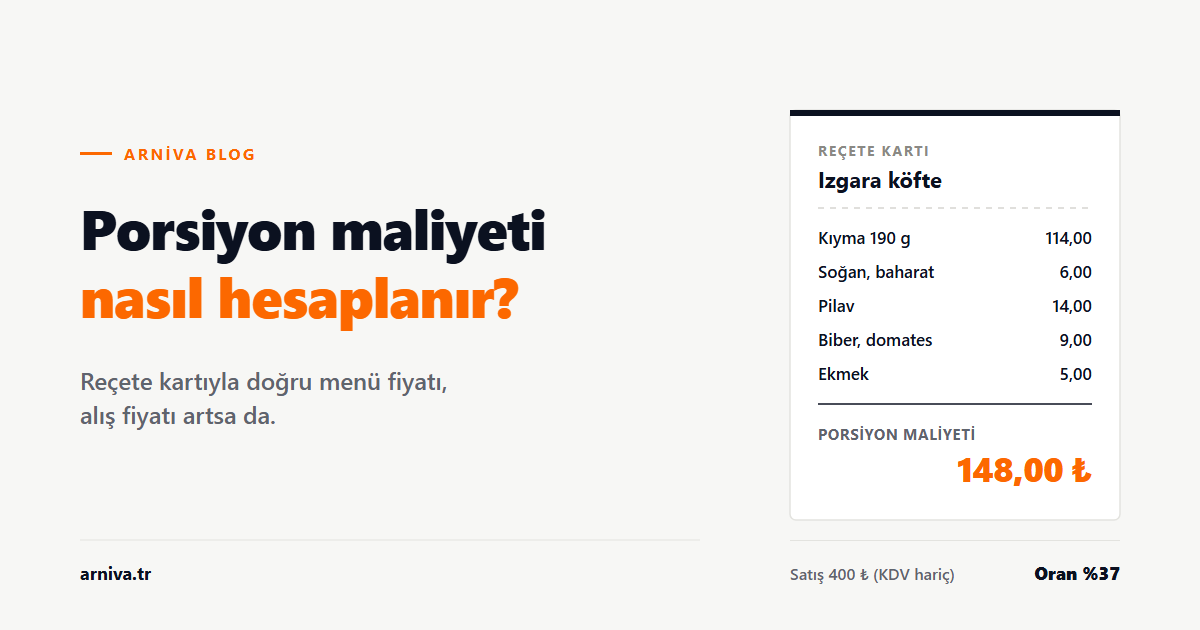
- Ground meat: For 180 grams of kofte, 190 grams are used, including the loss from kneading and shaping. If the kilogram is 600 TL, then 0.190 × 600 = 114.00 TL.
- Onion and spices: 6.00 TL
- Rice pilaf: 14.00 TL
- Roasted pepper and tomato: 9.00 TL
- Bread: 5.00 TL
Total portion cost is 148.00 TL. If the sales price of this plate excluding VAT is 400 TL, the cost ratio is 148 ÷ 400 = 37 percent. It is important to make the calculation with the price excluding VAT; the VAT collected is not revenue for the business.
The yield loss allowance clarifies the calculation: if the ground meat were written on the recipe as 180 grams without loss, the cost would appear as 142 TL. A difference of 6 TL per portion looks small; over a thousand portions a month it amounts to 6,000 TL, and a correct recipe makes this visible from the start.
When the purchase price changes
Now suppose the kilogram price of ground meat rises by 15 percent to 690 TL. The ground meat cost rises to 0.190 × 690 = 131.10 TL, and the portion cost becomes 165.10 TL. If the menu price does not change, the cost ratio rises from 37 percent to 41.3 percent. To maintain the same ratio, the price excluding VAT would need to be approximately 446 TL.
For a single product this calculation is easy. The difficulty begins when there are dozens of products on the menu and shared ingredients in each. When the price of ground meat changes, kofte, lahmacun, manti and kıymalı pide are all affected at once. If the recipes are recorded in the system, the new purchase price is reflected in the cost of all these products together. This way you do not need to recalculate dozens of products one by one.
Five habits of a correct calculation
- Account for yield loss. Writing the gross quantity actually used in the kitchen on the recipe shows the cost as it is.
- Work with the current purchase price. A calculation made with the price on the latest invoice provides a solid basis for today's decision.
- Include the small items too. Sauce, oil, bread and the delivery container are small on their own but decisive in total.
- Record comps and waste. When a dropped plate, a returned order and staff meals are recorded, stock and sales reconcile with each other.
- Serve portions by weight. When the grammage on the recipe is also placed on the plate exactly, the calculation holds in the kitchen as well.
The recipe card is the agreement between the kitchen and the till. The price at the till is based on the recipe followed in the kitchen.
Compare calculated consumption with the count
Once recipes are entered into the system, the "expected" ingredient consumption can be calculated from the portions sold in a period. Comparing this with the actual consumption found in the period-end count is one of the most effective steps in cost control. The difference arises from waste, comps, incorrect portions or unrecorded issues. A business that monitors the difference every week makes the necessary correction in the same week without waiting for the end of the month.
To start, the recipes for the entire menu do not need to be ready. The best-selling products are the ones that most affect profit; write the first recipes for them, then move on to the rest of the menu.
How does it work in Arniva?
In Arniva Restaurant POS, stock tracking and recipe management (Cost Production) work together. With purchasing management and daily cost tracking, purchase prices remain on record; product-based analysis and cost control are performed in sales reports. When a new price is set based on cost, with smart price updating the change is reflected from a single panel to branches, POS devices, QR menus and online ordering platforms.
If you would like to see how it would be set up in your business, you can review our restaurant and smart price updating pages and request a demo. For your questions, you can reach us at 0850 307 80 80.